Travels into The Heart Of Darkness

We would like to say that Koyambedu at predawn, pre-adventure, is inspiring. However, our story begins in a slushy bus terminus alive with the scent of rotting vegetables. We scramble into the bus to Chidambaram, settling on seats shiny with grunge. The mission is to reconnect with Pichavaram, the subject of the first piece in MetroPlus’s popular Road Less Travelled Column, which ran for over four years starting November 2003.

Following RLT tradition, we’re buffeted by wind, burnt by the sun and drenched with rain over the course of the journey. Emerging at crowded Chidambaram — looking vaguely Rastafarian with hair matted with rural grime — we swat amorous flies, elbow away friendly moustachioed men and teeter through suspiciously smelly slush, muttering darkly about Nature being overrated.

But, the journey’s just beginning. For some reason people always seem to enjoy tales of reporters put through trials of fire. Admittedly, it’s inexplicably satisfying to read about writers balancing on stinky fish carts, climbing sweltering rocks and crawling through spooky caves (all genuine MetroPlus RLT experiences) over a cup of comfortable coffee at home. It’s less fun when you’re acquiring a glorious Bob Marley hairdo miles away from your (sniff) hair stylist, (sob) shopping mall and (sigh) coffee bar.

Fortunately the waiters at ‘Vandayar High Class Vegetarian’ restaurant are friendly, despite our clearly irrational demands for a menu. (“Meals, madam, meals. Only meals.”) About six of them wait on us, giggling manically as they advise us on the best way to reach Pichavaram, about 16 km away.

Outside, the sun seems brighter and happier than usual as we clamber into an auto and zip towards the mangroves. Moving deeper into the villages, the auto weaves between goats sprawled across the road like languid Roman emperors, and the breeze gets cooler as the sky gets darker. It speeds unsteadily through emerald fields, tiny huts and flashy statues. Along buildings painted in a tasteful blend of neon green and violent orange. Very Manish Arora. Little seems to have changed since Shalini Umachandran explored Pichavaram five years ago for RLT. The road still boasts potholes, gaudy fertilizer adverts and statues of politicians painted in gold. The TTDC complex, which was under construction when the first RLT was written, is now ready. But it’s still rather basic. There is however a watchtower with a surprisingly sophisticated telescope through which we’re shown the glittering Nataraja Temple in Chidambaram, almost 10 km away as the crow flies.

TTDC’s gushing website states Pichavaram offers “abundant scope for water sports such as parasailing, rowing and canoeing.” In reality, there’s still only one thing to do here. Take a boat into the mangrove forest.

Located in the Vellar-Coleroon estuarine complex, which is the northernmost part of the Cauvery delta, the brooding mangroves form lush forests that spring out of the water. Covering over 400 hectares, these hearteningly healthy trees, with their glossy green leaves, support a bustling community of varied wildlife: birds, insects and animals.

The row boat glides through intriguingly intricate passages of hanging roots carved out by the boatmen. It’s suitably mysterious: an enchanted wood. Sleek crabs scamper past, majestic falcons strut about, elegant kingfishers preen. In the background there’s the constant hum and flutter of insects and birds. It’s magical and yet strangely eerie: Like a huge multipurpose movie set, perfect for “Narnia” as well as “Omen”.

According to boatman Rajendran, hundreds of tourists wind through these waterways during the tourist season, which coincides with school holidays. Fortunately for us, there are no squealing children around. We’re alone. Like valiant explorers.

The azure sky’s perfect, especially once with our feet trailing in the cool water. Schools of tiny fish get competitive and race our boat, showing off their acrobatic jumps in quick flashes of silver. Besides being undeniably decorative, these mangroves absorb excess nitrates and phosphates thus preventing water contamination. They also act as a buffer, minimising damage from raging cyclones. Best of all, they’re not yet a popular destination, making Pichavaram one of the few places you can hear nothing but Nature breathing.

Though, if you’re staying overnight Nature tends to turn into the class bully. Our chaotically coloured room, with damp spots on the roof, flourishing ant community and cheery lizards, can only be accessed through damp fields rife with cows. Since there’s no phone, we’re advised to “open door and shout loudly” if we want anything. By 5 p.m. our boat ride’s done. “What else is there to do?” we ask. “Nothing.”

So we climb the watchtower and watch the sky slowly turn a brilliant orange and the sun sink in a burst of gorgeous hues. In minutes the sky begins to glitter with stars. Suddenly we see a fiery shooting star streaming ceremoniously across the sky. Minutes later the electricity fails, and we’re soon back in our tiny room, gingerly crouched on the bed in pitch darkness, hoping the giant spiders don’t find us. Beyond the window, alive with scurrying ants, the mangroves glimmer mysteriously in the moonlight.

Pichavaram’s not changed an iota in five years. Which is frustrating. But also fabulous.

SHONALI MUTHALALY/ PRIYADARSHINI PAITANDY
The making of the Reluctant Gourmet

“Shame on u Shonali, u r a saddist … by the way we the people have a misconception of fine dinning in fact there is nothing called fine dinning, its good dinning. Appreciate what’s created rather than sounding to be a saddist” (sic)

(Anonymous hate mail from restaurateur, circa 2009)

I try. After all no one wants to be a ‘saddist,’ which I’m presuming is a crafty mix of sadism and unhappiness. It’s so much easier to be charming. Restaurateurs love you. Beaming chefs unveil complimentary desserts. Cheerful waiters hover fondly, sending occasional flying kisses. (Okay, so wistful imagination runs away with me occasionally.)

It must be admitted, not everyone loves The Reluctant Gourmet (RG). Ironically, in hindsight, that seems to be what makes this column work.

Just as our grammatically-challenged ‘saddist’ friend points out, people do “have a misconception of fine dining”. (But then she said ‘dinning’, which might just be a completely different thing.) As the country’s culinary scene grows at an exhilarating, not to mention bewildering, pace, pretentiousness sometimes overshadows quality. Ambition overrides ability. And, pricing derides common sense.

How does a food column make sense of all this? Especially when its writer is neither a cook nor a restaurateur?

Well, when the column launched, in response to the growing interest in food among Chennaiites, we decided to make it sound like an unabashedly honest friend. The kind of person you call for an opinion on where to eat. Or what to wear. Or to check whether yellow looks good on you. Brutal honesty offered with chatty updates became the RG tone. It worked, and the column eventually went national.

I don’t claim to be an expert, but I do try. So, instead of preachy lectures, RG canters excitedly into the colourful world of food, tugging its readers along — so far we’ve plodded through muddy vegetable markets, animatedly broken warm bread with baker-convicts at Chennai’s Puzhal jail and nibbled nervously on ‘hashima’ custard, thickened with the ovaries of a snow frog in a hip Singapore restaurant.

Restaurant reviewers have to be tough, because people should get what they pay for. It’s infuriating to go for a celebratory meal only to get lacklustre food, snotty service and a ridiculously high bill. This is my way of fighting for culinary justice. At the same time, I realise fairness is essential. After all, a lot of work goes into every restaurant opening, every menu and every meal. As everything in life, the truth is never black or white, instead, a perplexing range of greys.

Judging by the endearingly friendly mail from readers, this approach seems to work. (On the flip side, the RG tone’s proved so comfortingly familiar I’m called constantly by friends, acquaintances, friends of acquaintances and acquaintances of friends to provide hour-by-hour restaurant updates, food explanations and cocktail suggestions.)

As the opening letter shows, some of the restaurant folk are less enthusiastic. My friends are terrified to eat out with me, because they’re worried about chefs spitting in our food. (For the record, I think chefs are fabulous people. Shiver!) There’s the occasional threat from furious investors. And, after a review that’s less than flattering is published, I tend to stay away from the restaurant for about three months. I figure that’s long enough to ensure I don’t get a steak knife artfully positioned between my ribs. (It would just ruin my lovely Miu Miu evening wear.)

Actually chefs are astonishingly open to criticism. Many even have a reassuringly quick sense of humour. I once referred to a chef as Shylock, because his portions were tiny. The next time I was at his restaurant (after the obligatory three-month wait) with friends, a chocolate cake was delivered to our table. It has just three words across, in happy vanilla icing — “With Love, Shylock!”

In fact, The Reluctant Gourmet works, thanks to the many chefs, cooks and foodies, who’ve patiently explained ingredients, techniques and recipes to me over coffee, hot stoves and meticulous cookbooks. That’s also how it gradually acquired its politics — pushing local flavours, promoting food diversity, supporting sustainable eating. And, of course, its recurring theme — exploring the amazing way food from every part of India is so uniquely distinct. In this deliciously diverse country, food styles vary every 100 km or so, and every single household has an individual recipe for even something as basic as dal.

The restaurant scene changes almost every week in Chennai alone, which is where I’m based. In 2006, we wrote a MetroPlus food guide to the city, which went into reprint after reprint. Today, it would be a very different book. The city now has water sommeliers, wine libraries, and sashimi counters. The same things are happening across the country.

Things can only get better.

Meanwhile, I try to stay incognito to get an authentic experience. Sometimes I fail. So I’ll admit it: my prawns are bigger, my parathas fluffier, my pizzas more generously laden with cheese.

Think that’s fun? You try eating with a dozen hostile men in suits studying you all through dinner, like you’re a particularly twisted lab rat.

Though it must be admitted, drama like that makes for a good story. Even if that does make me — sigh — a bit of a ‘saddist’.

Clowning Around With Tragedy

Great literature guards its secrets. Which means that some of the world’s best stories are also some of the most undemocratic, as they’re told in intimidating language ridden with layers of meaning. Synopses don’t help either: too much gets lost in translation.

“Hamlet The Clown Prince”, therefore, is a spunky approach to unlocking a celebrated tragedy in a way that connects with everyone, ranging right from Shakespeare aficionados to the audience members who believe ‘Iambic pentameter’ would make a great name for a rock band.

This version is really about enabling access. About taking a text that’s relevant to only a section of the public, and pointing out why its compelling story, rife with emotion, is as relevant today as it was in the 1600s when it was written in a completely different social atmosphere and political climate.

It helps that the clowns unapologetically begin the play by dispensing with Shakespearean language. “You say thee, thou, thy — the audience will die!” There are also plenty of nods to familiar popular culture, hilarious when juxtaposed with tragedy. Take the entrance of Horatio, Hamlet’s best friend, in the eerie ghost scene. The clowns sing “Who you gonna call: Horatio” to the Ghostbusters’s tune. Or Hamlet replacing the King’s “How is it that the clouds still hang on you” with the Joker in Batman’s now cult-line — “Why so serious?”

Funny-faced and sad-eyed, these endearing clowns serenely unlock, cheekily re-craft and cheerfully re-tell the story by hand-holding the audience and guiding them into the play’s core. Although the production’s stated to be in gibberish, in reality only chunks of it are. The rest is an impudent melange of choppy English rendered in Italian and French accents.

Director Rajat Kapoor and his cast’s greatest achievement is staying faithful to the play, while upturning the text. Managing to be irreverent without descending into the realm of yet another Shakespeare-inspired spoof.

With very basic props, the focus is on six clowns in appropriately outrageous costumes and makeup. Their over-the-top eccentricities, Chaplinesque slapstick and often melodramatic acting is in sharp contrast to the minimal, but cleverly manipulated lighting and sets, making for heightened drama. Seeing how the production works on edgy contrast, it will probably benefit from a few cuts, since it tends to meander in parts.

The clown troupe simmers with personal emotion swinging erratically between love and hate, often resulting in them forgetting about the play and bickering between themselves. It’s to the credit of the actors that they’re so comfortable in their confusing on-stage skins, considering they’re playing passionate people playing histrionic clowns playing characters in tragic Hamlet.

The lady clown playing Queen Gertrude, for instance, is still sore about having been dumped by Hamlet, who breaks off from a soliloquy to complain “she’s always bringing the bedroom to the stage.” She later gets back at him by sitting on a blameless, and clearly startled, member of the audience, naughtily giving him both her phone number and flaming red garters. The fourth wall is, in fact, breached constantly, as the clowns alternate between picking on the audience and asking them to mediate in their squabbles.

However, what stands out are the unadulterated blasts of pain and dark emotion, which seem starker than ever in contrast to the reckless tomfoolery. Writer Paulo Coelho once said ‘The funniest people are the saddest ones’. “Hamlet The Clown Prince” is funny. It’s also achingly sad.

(“Hamlet The Clown Prince” was staged in Chennai at Museum Theatre as part of Prakriti Foundation’s Hamara Shakespeare Festival.)

Tweet Yourself Thin

Do fudge brownies gobbled with your head in the fridge count? After all, if nobody sees you, it’s okay to discount the calories, right?

Sigh. Not anymore. Thanks to Twitter (the micro-blogging service that’s captivating much of the online world) and the kaleidoscope of imaginative applications it’s inspiring, it’s becoming next to impossible to live your life under a veil of convenient secrecy.

While Twitter might be dramatically revolutionising business, politics and pop culture by changing the way people share information, it’s also creating all kinds of upheavals in the world of food.

One genre of applications are changing the way people cook, dine out and eat by enabling users from the across the world to share pictures and information on their every meal. Since twitter is so democratic, it means that anyone anywhere can post a picture of anything they want anytime. Which — as you can imagine — leaves a lot of room for experimentation, pushing boundaries and plain goofing off.

An application like Nom.ms, for instance, which encourages users to tweet pictures and a couple of lines of text on every thing they eat is fascinating for so many reasons. The most obvious, of course, is that for foodies it’s a fun way to learn about food, ingredients and recipes, by seeing how people around the world eat. User Trendy, for instance, had Angel hair pasta with tomato sauce for dinner. She cooked it with red banana peppers, onions, green beans and shrimp. She’s also addicted to what she calls the ‘Everything but the kitchen sink cookies’ — “My dad gets ‘em from the farmers’ market — they’re amazing. Oatmeal, milk and white chocolate, macadamia nuts, walnuts, raisins…” Talk about getting a real, unbeatably immediate and artlessly evocative slice of life!

Of course there’s the danger of getting overly inspired, and eating your way into an obnoxiously large pair of jeans. Enter TweetWhatYouEat.com (TWYE), an inventive way to keep yourself honest using the convenience of twitter. Which brings us back to you brazenly scoffing fudge brownies with your head in the fridge. (Yes, I’m talking to you.)

An online food diary, TWYE, enables you to enter everything you eat instantly, making it extremely difficult to cheat. Alex Ressi, founder and lead developer of the application, says the site has more than 8,000 followers, 30 per cent of whom post regularly. He says that it’s the accessibility of twitter, “being able to post updates from your IM, mobile phone or the web,” that drew him to the platform.

To make calorie counting easier, the application even has a ‘CrowdCal system’. Alex says this is the Internet’s first completely crowd-sourced calorie database. When active, it auto-fills food entries with the appropriate calorie value based on what other users in the community have entered. It’s an ingenious way to cover a huge variety of foods from every country.

Of course, since this is twitter, the biggest impetus comes from the community. People clearly find it easier to diet with a supportive group — even if it consists of people across the world who they’ve never met. The forum is alive with everything from cries of help (“pineapple upside-down cake. Anyone has alternatives?”) to shrieks of despair. (“I’m sorry — but there is NO SUBSTITUTION for McDonald’s Medium French Fries when you’re stressed!”)

“People need to be able to share in their success and lean on others,” says Alex, adding that they’ve had some inspiring weight loss stories. “I’ve had people write in and share stories about 20 pound, 40 pound and the most dramatic — a 70 pound weight loss using the Tweet What You Eat tool and working in conjunction with a nutritionist.”

Besides, it’s encouraging to feel that you’re not the only one with so little self-control. Take “Heyimskye” whose bio states she’s “losin weight one fat cell at a time.” She began yesterday with “salad with romaine lettuce.” A little later comes the entry: “mini muffin you will be the death of me!”

Now where’s that fudge brownie?

Eating Flowers In Kashmir

I’ve been fascinated with Kashmiri food ever since i went to Srinagar earlier this year. After three days of elaborate wedding food, cooked by aged experienced traditional cooks, however, i was convinced it would be next to impossible to replicate. Till i was given Koshur Saal to review. Not only was it a fascinating book, but it actually made me feel like i may be able to recreate some of the food i got addicted to in Srinagar.
First on the list, is creamy Mutton yakhni made with curd and intricately laced with spices in that signature Kashmiri way.

————————————–
Kashmiri food is alluringly unfamiliar. Kashmiri food is comfortingly familiar. This contradiction is Koshur Saal’s greatest advantage.
Written by Chandramukhi Ganju – yet another Non Resident Indian cookbook author – Koshur Saal’s a resolute, practical and authoritative attempt to record the culinary culture of her community.
Perhaps the reason so many NRIs write recipe books is because distance brings the necessary perspective to really understand nuances and record processes. After all, the food your mother and grandmother cook might seem ordinary, even boring, as long as you are at home eating it every day. It’s only when you try recreating it in a completely different set-up that you appreciate the techniques, skills and measures necessary for every recipe.
The advantage of having someone like Ganju – who now lives in California – hand-hold you through this book is that she’s familiar with the challenges of creating a reasonably authentic meal in a situation that’s a world away from the recipes’ origins. More importantly, thanks to her popular Koshur Saal website, which draws Kashmiris hankering for a taste of home from across the world, Ganju’s used to explaining processes to amateur as well as seasoned cooks. The book’s precise instructions, therefore, are accompanied by all kinds of tables, photographs and charts, listing everything from the customary glossary of translations (with meanings in Kashmiri, Hindi and English) as well as step-by-step picture guides to help deal with vegetables like the unusual Kohlrabi (vaguely similar to a turnip). You can choose how much, or how little, information you want to use.
For the many Kashmiris who live all over the world, and dream incessantly of creamy Yakhean mutton curry, or pulav interspersed with juicy morel mushrooms, or simple rice bread paired with Kahwa tea fragrant with cinnamon, this a realistic guide, empowering them to make these meals almost anywhere. Ranging from basic omelettes (with chilli, ginger powder and fresh cilantro) to the ever-popular chicken Rogan josh, with its intricate web of aromatic spice, the recipes are fairly simple.
There are alternatives suggested for ingredients that are rare or unique to Kashmir. Such as leafy mallow which can be substituted with spinach. Since this book is geared chiefly towards American NRIs it suggests ingredients easily found in their supermarkets or Korean/Chinese/Indian food stores, which aren’t always available to all Indian readers, which can be annoying. Take lotus root, shiitake mushrooms or Granny Smith apples. Or the directive to replace pacchin, a Kashmiri flying bird, with ‘Cornish hen’. Its high time NRI writers take into account the Indian situation, when they write on Indian food. After all, this is a huge and profitable market.
You really don’t need to be Kashmiri to use and enjoy this book. Its most charming feature is how unwittingly exotic it’s turned out to be. Unlike the many authors who take advantage of ‘exotic India’s’ marketability, Ganju’s relatively naïve approach is refreshingly unstudied.
Of course this has its disadvantages. For instance, she’s helpfully added an entire section on other Indian food, which dilutes the book’s novelty. Pictures are amateur, often unimaginative and sometimes downright unappealing.
Yet, these pictures are functional. Often they’re also endearingly helpful, pointing out what each vegetable looks like and even how some of them should be cleaned.
Clearly, Koshur Saal simply wants to share information, which is why it’s direct, unfussy and unpretentious. No glossy pages, chic layouts or fancy prose. Yet, it’s a compelling read because it’s so unique.
Though this cuisine is known world-over, thanks to the Kashmiri Diaspora, very few people actually know its specifics. There are surprisingly few books available, especially when compared to other popular Indian cuisines. Amazon, for instance has more than a 100 book on Punjabi food, but only lists a handful on this cooking.
The food uses a host of colourful ingredients available in Kashmir. Like green almonds, used to make fish. Also mallow, green cardamom and leafy wupal haak from the forests. Ganju also has recipes using dried vegetables, like brinjal and green squash, which were made in Kashmiri households to tide them through winter.
These ingredients might be next-to-impossible to source, but the recipes certainly make for an interesting read – especially when they’re accompanied by her explanations on their cultural significance.
After all, who can resist vicariously enjoying the image of Pumpkin flower fritters, made with cheery orange petals covered in a crisp golden batter?

Baingan Bhartha meets Olive oil

Mustard oil is good. Mustard oil is bad. Coconut oil is dreadful. Coconut oil is fantastic. Olive oil, on the other hand, is consistently virtuous. Apparently, it will fix your heart, make you thin, heal your family and walk your dog.

It’s astonishing how vociferous health gurus can get about cooking oil brands. Much of the hysteria is dedicated to making sinners and saints out of various blameless oils. Take mustard oil, loved by Bengalis for its intense, almost nutty flavour. Till popular opinion decreed that everyone should stop using it because it’s bad for the heart. Then came the discovery that it’s rich in omega-3 and antioxidants, which made it good for your body.

Confused? Well, that’s nothing compared to the coconut oil saga. For decades Malayalis happily fried everything in the fragrant, rich oil. Then, talk of saturated fats started doing the rounds, and suddenly it became the symbol for all that is perceived to be unhealthy about desi cooking. (Though one look at the old and vigorous Ayurvedic practitioners brought up on a steady diet of asli ghee, full-fat milk and coconut oil easily proves otherwise.) Till very recently, cooking with coconut oil was guaranteed to make most people recoil in horror. Now suddenly there’s a buzz about virgin coconut oil and all its fabulous benefits. This version of the oil (extracted from fresh coconuts and processed with no chemicals) is said to — believe it or not — actually boost your metabolism.

However, the popularly-acknowledged kingpin of all healthy oils is olive oil. If all the muscle behind its marketing is to be believed, it’s the panacea for all ills. It prevents heart disease. Lowers cholesterol. Virgin olive oil has a strong antioxidant effect, protecting against free radicals and the formation of cancer.

While it is true that olive oil is one of the healthiest of oils, it’s certainly not a complete solution. Every gram of oil — regardless of what kind of oil it is — contains nine calories. Which means one tablespoon is roughly 120 calories. What you really need to do to get healthy is reduce your intake of oil. Weight loss and health, unfortunately, all boil down to that same old mantra: fewer calories, more exercise.

The biggest problem with olive oil is that it is far more expensive than any of the other oils available in the Indian market. Honestly, if you can’t afford it, that’s alright. The truth is, as all our grandmothers have always known; there are plenty of other options. Try alternating between oils like refined peanut, rice bran, corn, gingelly and sunflower, just to name a few. Nutritionists now recommend consuming a mix of about three kinds of oils as each provides you with different essential fatty acids.

The second big hitch is that Indians feel olive oil’s flavours don’t work with Indian food. That’s probably true with dishes where the oil is a main component of the flavour, like the Bengali mashed potatoes with mustard oil or Kerala avial, which is topped with a spoon of sizzling coconut oil. But with a number of regular Indian dishes it actually works reasonably well.

Celebrity adman Prahlad Kakkar, a self-confessed “man of great excesses,” is an enthusiastic promoter of olive oil. On a cooking demonstration, which was part of a road show organised by the International Olive Council, he said “When you warm brandy, you release its secrets. It’s the same with a good olive oil: it’s fruity, it’s pure, you know it’s good for you because it lingers.” As he sautéed onions and garlic for baingan bhartha, their delicious aromas filled the room. “Olive oil’s like pure desi ghee,” he said, “It makes you remember home.”

Even if you don’t come from Spain, apparently.

Toss, Turn and Twitter

1:11 am. @gordon_ramsay: Bollocks, sorry for not using this. Someone’s showing me how it works. Hopefully this will…”
1:11 am (seconds later) @gordon_ramsay: “Fuck me. It worked.”

(Celebrity Chef Gordon Ramsey’s first posts on Twitter)

The world’s never been this small. Access has never been this easy. Celebrities have never been this real.
Twitter has opened up a whole new world of food networking, effortlessly bringing together Chefs, Food celebrities, home cooks and foodies. With more traditional forms of media, people like Gordon Ramsey, Martha Stewart and Jamie Oliver seemed distant, despite being everywhere. You could read about them, watch their shows, even read their blogs, but as familiar as they were – for all practical purposes – they were really just about as accessible as Mr Potato Head. Suddenly, thanks to twitter, they’re morphing from two dimensional, larger-than-life, pedestal-occupiers to real, living, breathing people with tempers, quirks and spelling mistakes.
The food world’s never been more exciting.
Now you get recipes directly from Martha Stewart. She’s even managed to master recipes that fit into Twitter’s 140 character limit. Like “GUACAMOLE Mix juice 1 lime, 4t crushed garlic, 5 chop scallion, 1C chop cilantro, 1 mince jalapeño + 3 ripe avocado.” Jamie Oliver, who comes across as warm, friendly and incessantly upbeat can help you figure out why your last pudding failed. Gordon Ramsey’s as refreshingly brash on twitter as he is on his shows, making for some fabulous stories from behind the scenes. “April Head chef at Claridges set the fucking kitchen on fire, we had to evacuate, Clooney and Pitt stood outside saying ‘fucking chefs’.”
Then there’s Heston Blumenthal, who made waves in the culinary world with his award winning Fat Duck restaurant, famous for food like Nitro-Scrambled Egg and Bacon Ice Cream. He transforms from celebrated culinary alchemist into a quirky real person on Twitter. While his first tweet ever announced “pickled herring with lemon rice garnished with grated brie for lunch,” he goes on to state not all his meals are cutting-edge culinary experiments. “Ever since my TV shows everyone expects me eating hogs heads and sheep brains for lunch. Ha ha… I usually end up with a simple soup and a roll at lunch if I am working. Soup is under rated you can make almost any flavour and its light.”
Most of these celebrity Chefs follow each other. Except for Gordon Ramsey, who follows just one person, despite having about 6,400 followers. This person’s Lennie Nash, or Chef Sandwich, who says he’s “writer blogging about retraining as a chef.”
In an e-mail interview Nash says Twitter has helped him as both a chef and food writer because it’s enabled him to get in touch with chefs across the world who would normally be very difficult to contact. And certainly impossible to stay in contact with on an everyday basis. “Just within food blogging there are many spheres – and you are able to find people with your exact outlooks and experiences. It’s also good for getting ‘breaking news’ and rumours on restaurant/cheffing topics,” he says.
Gossip? It’s simply delicious on Twitter to be honest. There’s Nash’s story about how Prince Philip phoned Heston Blumenthal to ask for his fish and chips recipe after eating at the Fat Duck. Then there’s the tweet about Curry Lounge, in Nottingham, creating the “world’s tallest poppadom tower. 1,052 poppadoms and 4ft 11in tall, beats record by an inch.”
Since the celebrity Chefs are on Twitter, and Twitpics, without their entourage of PR people, makeup artists and publicity managers, they seem so much more fallible, and thereby endearingly real.
Jamie Oliver for instance has two principal weaknesses. His cute daughter, who surfaces on twitpics besides pictures of his painstakingly hand labelled Gooseberry jam and freshly made potato pizza. “Bless look what my little daisy cooked. A daisy pudding. And she loves it and loves eating it even more.” And his spelling, which is far from perfect. (A word of advice though. Don’t point it out to him. The last person who did got this “Get lost you idiot I’m dislexic and I can’t spell so stick that in your pipe and smoke it!!! It’s better than being smug.”)
Blumenthal’s worried about his waistline. “Going for a suit fitting tomorrow. I hate it. There always seems to be more tape measure required every time.” And he’s also far from impervious to the inevitable twitter boors. “Half of the tweets are just insults and I have a temper problem at times and don’t want to get anything heated,” he says.
So why stay in?
Well, for starters everyone seems to be having so much fun. Blumenthal says he loves reading what other people are doing around the world. “Everyone’s doing and thinking something different.” He adds that its size and diversity also makes it a great sounding board for ideas.
Nash says it’s great from capturing and connecting with a specific audience or online community because it is so direct and immediate. “You can just put an idea out there, and it can quickly snowball into a ‘trend’ with everyone able to throw in their ideas rather than just celebrities or pundits. It is much easier to gauge what interests people, rather than just what interests you.”
So Blumenthal tells us when he’s “trying a new way of smoking deer with a blueberry smoke and serving with lemon and thyme covered garden peas.” And Ramsey gives us the inside story on his TV shows. “Taking live cook-along to the US, on Fox network, but I’ve been warned to watch my language. No cursing, that’s the deal. Bollocks.”
While the celebrities are the most obvious face of food networking, they’re just one slice of the pie. As Nash says this is “definitely the best tool I’ve come across for food networking because it is largely recommendation based – and therefore the best sites tend to shine through and attract followers. The mobile aspect using iPhones etc means people can blog or send pictures directly from an event rather than wait to get back to the office to write them up.”
As a result there are a bevy of colourful food writers who keep the site alive with great ideas. Like PuddingQueen who talks of wedding cakes made with Buttermilk, wild strawberry and more than 24 eggs. Or “Lemon and lavender sandwich biscuits with lemon cheese and lavender lemonade – its going to be a floral tea this afternoon!”
Things can only get better. Already Blumenthal’s running a competition on his page. “Doing a Harry Potter themed meal around October time for about 50 people 10 of which I will choose from twitter (UK only).” He’s likely to get flooded with replies, considering how many food nuts there are on the site, judging by the handles: MsMarmitelover, GingerGourmand, ThePorkyDrunk, TheMeadmaker and even LambshankRdmptn!
As for happy endings? Who can resist the story of Gregg Wallace, TV star ingredient-expert, who’s calls himself the “cooking woman’s crumpet.” and goes by Pudding Face on Twitter. Pudding Face made contact with Heidi Brown, who’s 17 years younger, on Twitter. “@Heidipopps You’re very special./ @Heidipopps missed you, but then you know that. Xxxxxxxxxxxx.”
They’re now married.
So what’s a celebrity foodie romance like? Champagne and caviar on a private jet? Not quite, according to Pudding Face’s twitter update. “Very romantic evening with my lady. Dinner from Tesco Metro, eaten on a balcony in Crewe overlooking Mc Donalds. Sun setting on Large fries.”
Honestly, who needs reality TV?

Seeking culinary Utopia

Writing love notes in History class? After all, you figure, the past can bury its dead. It’s far more important to get yourself a date for dinner, right?
Well, it might surprise you to know how dramatically your dinner – irrespective of what you’re eating – has been influenced by history.
Every kind of cuisine — whether it classic French, hip Californian or traditional Indian — is shaped by its past. By invaders, traders and rulers. Peace, wars and politics. Love.
Think that sounds like the voiceover to some cheesy historical drama (preferably accompanied by a sweeping Oscar-winning musical score)? Well, then take the story of Catherine de Médicis, a princess from Florence, Italy. When she married King Henry II of France in the early-1500s, she moved with an entire entourage of talented Italian Chefs, who proceeded to impress everyone with their sophisticated food. Of course what was served and eaten at the palace set the tone for dining tables across the country.
Food is arguably the most powerful expression of culture. However since food customs are so sensitive to external influences, traditional recipes, ingredients and cooking methods are rapidly being influenced by quick-fix methods and the addictive all-pervasive trend of global cuisine. The most accessible foods of every culture — Mexican nachos, American burgers, Indian curry — are conquering dinner tables the world over.
But, simultaneously, taste-tourists are travelling the world in search of food thrills, culinary epiphanies and cooking discoveries.
So where’s the next food frontier? Try the relatively undiscovered countries of South Eastern Europe. Also known as the Balkans, stretching across Albania, Bulgaria, Montenegro etc.
Countries like Bulgaria unwittingly managed to preserve much of their traditional food culture thanks to Communism, says gorgeous Chef Vita Bozadzhieva, who travels the world introducing people to the food.
At the Raintree Hotel, in Chennai, where she’s conducting a Balkan food festival, she talks of growing up in a very different environment where people worked hard, ate at home and used only local products and produce. “I am 33 years old now,” she smiles, “When I grew up, it was like Coca Cola, ‘Wow!’ Restaurants then served mainly either Turkish or Balkan food. “The Turkish were in our city for about 500 years. So we have super-mixed culture,” she says, adding that nevertheless, even now the Balkan countries have a cuisine culture that is distinctly different from the rest of the world.
“Our country is not so economically developed,” she says, “Still we believe that the wife must cook for her husband. I’ve grown up in that culture.” As a result, she says, their food is more homey. After all, it evolved in kitchens, not restaurants. In the hands of housewives not Chefs. And because of Communism, it marinated in tradition, undisturbed by outside influences for about three decades.
“Till about 15 years ago, it was very closed,” says Chef Vita, “People were not travelling so much. It was also very difficult to go out of the country.”
Hence the cuisine, influenced by a host of ancient invaders including the Romans, Greeks and Turks, had time to steep and simmer for a while. Appropriately enough, that’s how a lot of their food is prepared. “We use lots of herbs, and the food takes a long time to cook, to soak in all their subtle flavours,” says Chef Vita. “We also bake a lot. Every kitchen has lots of ovens.” They’re also one of the few places left in the world, besides India, where they set their own curd, instead of just buying tubs from the supermarket.
This food is necessarily rare right now. After all the Chinese and Indian emigrants travelled the world with baggage bursting with of home-made spices and recipes, thus getting huge chunks of the world enamoured with their food. Meanwhile, places like the USA, Britian and many Europian coutries (think Greece, Spain, Italy) gain converts thanks to mix of pop-culture and tourism Meanwhile, dishes like Chef Vita’s fragrant stewed lamb, served with chunky potatoes in thin gravy, remain undiscovered since it’s only recently that the people of the Balkan’s started to travel, and welcome visitors. There’s one more hurdle. “We’re a small country. For example you take a car and drive for six hours and you have reached the other end,” laughs Vita.
This, however, means Chefs like her have a distinct advantage that sets them apart.
“For me, I believe we are born and grow up, where we must be born and where we must grow. If I was born in a Communist regime, it was because that was what was right for me,” she says. “Now I realise it is an advantage. I’m different!”
Which is really the most exciting thing about food cultures, when you come to think of it. This is history that you can actually taste.

Smoky kebabs in a Kashmiri Tent

Cross-legged attack on Wazwan. Our quick mid-kebab pose for the camera.

Cross-legged attack on Wazwan. Our quick mid-kebab pose for the camera.

Singing and spinach make for a charming, if unlikely, combination.

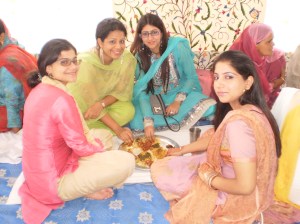
It’s a bracingly cool morning in Srinagar, where we’re attending a friend’s wedding. We’re cross-legged on the lawn helping her aunts and grand-aunt de-stalk crackly-fresh spinach leaves for the wedding lunch. As the community unites, from different parts of the country or city — which involves braving bandhs, curfews and random stone-pelting — to celebrate, preparations to feed about a thousand people are already in full swing.

The women sit in a circle singing beguiling folk songs, steadily working their way through baskets piled high with the leaves. All the while, a kahwa lady hands out cup after cup of the soothing sweet green tea, fragrant with saffron, spiced with cardamom and afloat with crisp almond slivers, from a silver samovar, which bubbles ceaselessly through the three-day-wedding thanks to cleverly concealed cavities holding glowing charcoal. Beside it, there’s a basket of tandoor-baked soft Kashmiri bread from down the road for breakfast. It’s necessarily light. After all, everyone’s gearing up for wazwan — an elaborate, formal, overwhelmingly generous meal integral to Kashmiri Muslim weddings.

A huge tent has been set up next door to the house for the preparation of this meal, which is served for lunch and dinner through the wedding and features anything from 20 to 44 different courses — most of them meat, mainly mutton. The mathematics is precise and has to be adhered to, following tradition. Shahid Mir, brother of the bride Shaila, explains it, as he walks us around the quaint kitchen-tent, which bustles with activity — hoards of oversized furiously bubbling pots, crackling wood-fires and about ten cooks preparing the meal with the kind of regimental precision, poise and co-ordination that can only come from having done this hundreds of times before.

“For thousand people, they use 120 goats,” he says, “and about 1,100 chickens.” Wazwan is served in huge plates, each of which is shared by four people. “Every plate holds around 4 to 5 kilos of meat.” The brilliance of the cook really comes into play here, because every dish tastes distinctly different. Like the conductor of an orchestra, the head cook directs and guides the team. With minimal talk, responsibilities are divided. One group cuts the meat, ensuring it’s halal. The next lot sits in a row, pounding endlessly to tenderise it. The steady thud’s rhythm is surprisingly cohesive with the folk songs, also sung through the wedding. Another group does the blending, boiling and frying.

With 24 courses on the day of the wedding, this is — of course – far more than most people can comfortably eat. However following long-established protocol handed down through generations, Kashmiri families ensure that there’s no reduction whatsoever in the amount of food served.

After we grapple helplessly with a couple of meals, wasting embarrassing quantities, Shahid’s mom Shamima explains the mystery of how the rest of the wedding guests seem to be clearing their plates. It’s a delightfully practical solution. To really enjoy the nuances and flavours of every course, guests are given bags, so they can just pack up the excess food and take it home.

As the tempting scents of smoky kebabs, spice-laden curries and smoking-hot ghee begin to weave their way across the garden, we sit down for our first wazwan experience. The boys in the family do all the carrying and serving, so one of the cousins sets down the tash-t-nari, a quaint silver basin accompanied by a jug straight out of Arabian nights so we can wash our hands. Then comes the plate, piled high with rice, topped with a dash of cooked spinach curry and a dense, meaty gravy made with lamb liver, kidney and intestines.

Then, the wazwan starts moving faster. Scalding chicken red curry served with a huge ladle is carefully poured on the rice, along with a huge meaty piece of chicken for each of the four people sitting around the plate. Then come the tender sheek kebabs. Rogan josh, fiery with red Kashmiri chillies. The delicious tabak maz, which are flat rib cuts cooked in spiced milk and then fried in pure ghee till they’re dark and crackling. Delectably spongy paneer in a rich tomato sauce. Gushtaba, soft mutton meatballs cooked in a gravy of fresh curd, end the meal.

Not surprisingly we loll about like pythons once we’re done. More kawah. More singing. The thudding from the tent begins again. After all, there’s wazwan for dinner.

Some Like It Hot

Whatever happened to puddings?

Nobody seems to make them at home anymore. You remember the old staples of course. Chunky comforting bread and butter pudding, made every time there was an avalanche of bread in the refrigerator. Obstinately unfashionable cheesecake from the days before people even knew what ricotta was, smothered in lashings of condensed milk on an unsteady base of crumbly Krackjack biscuits. And that never-fail chocolate biscuit pudding, a tower of Marie biscuits softened in milk, all layered with a gooey cream of decadently over-sweetened chocolate.

Now, desserts seem to be all about the swank-factor. If it’s not ridiculously difficult to make, involving hours of back breaking labour in the kitchen, it better have exotic ingredients. And exotic in the times of New York-today-Tokyo-tomorrow world is not an easy requirement to fill. At the very least it requires something along the lines of semi-naked tribal people gathering under the moonlight and singing to the mountains as they process/ pluck/grow the ingredients. (Also difficult in this day and age. You’ll need to confiscate their BlackBerries for one. And I don’t mean the ones you use to stuff an old-fashioned piecrust.) So how do you keep up with the Joneses in such competitive times?

Return to the good old days, of course. When puddings were made with whatever was in your larder. When cakes were expected to be more tasty than pretty. And portions didn’t come accompanied by calorie counts and hysterical health warnings. The main difference really seems to be the fuss involved.

Suddenly baking is seen as an occupation for just chefs. People who can easily whip up an elaborate meal for an entire family go into a tizzy at the prospect of making dessert. So it’s either outsourced to a caterer or bought from a bakery/restaurant/hotel. The thing is, a pudding is actually far easier than making a chicken curry, or biriyani or payasam. Anything you make at home is likely to taste better than what you buy, even if it’s just thanks to the superior ingredients you’re likely to use. Besides, you don’t have to worry about desserts necessarily being elaborate, hip or wickedly lavish. That’s a current trend that’s likely to die a natural death. Just like tightly permed hair, hot pink tights and those hideously uncomfortable, vertigo-enhancing platform heels.

I went to a boarding school in Ooty where pudding was the natural ending to every supper, and they managed to dish out a different pudding every day of the week for hundreds of hungry students. Admittedly not all were great. There was the ghastly Grape Mould, which arrived warm and frighteningly purple. The exasperatingly healthy Blancmange, made from all the extra milk delivered. And a dry sponge cake, dribbled with thick jaggery. But their trifle pudding, a delicious jumble of cake, jelly, fruits and custard was clearly the hot favourite. Ironically, it was also probably the easiest to make.

That’s really the best thing about puddings. Often, the most memorable ones require very little work, and yet look astonishingly impressive when they’re done. Think of a fruit filled melon. Or a chocolate fondue. Or even bits of cheese and pineapple chunks stuck into a big, unpeeled pineapple. Homemade puddings don’t even need to be exceptionally pretty, because everyone loves culinary nostalgia. Besides, your biggest fans are likely to be children. And it’s highly unlikely that you’ll find a child that draws himself up snottily and demands chilli-tinged chocolate mousse, specifically from Ghana, when he’s handed a still-warm pastry shell, laden with tangy, golden, sweet lemon curd.